


-Neil Hammond

In the mid 20th Century, Benjamin Bloom and his team set out to boldly map the full landscape of human capability. The thing is, if you look at how his work is actually used in the wild today, you’ll find a highly flattened, single-dimension version of his original vision.
To Bloom and his team’s credit, his original vision was much wider. Most people who use it today seem to have little idea that the taxonomy scale they revere is only one of three parallel scales the team originally introduced.
If you’ve been following our series on the Learnbase Learning Focus Map, you can probably guess which quadrant is occupied by the particular scale everyone uses.
You guessed it. It sits squarely in the Activity Focus quadrant (focussing on resources, tasks, courses and pathways).
It provides verb-based variations on how to formulate what a learner should “do” with the activities they are set by the people who set them. It is highly structured, notionally at least easy to measure, and incredibly safe, like a mid-century sideboard.
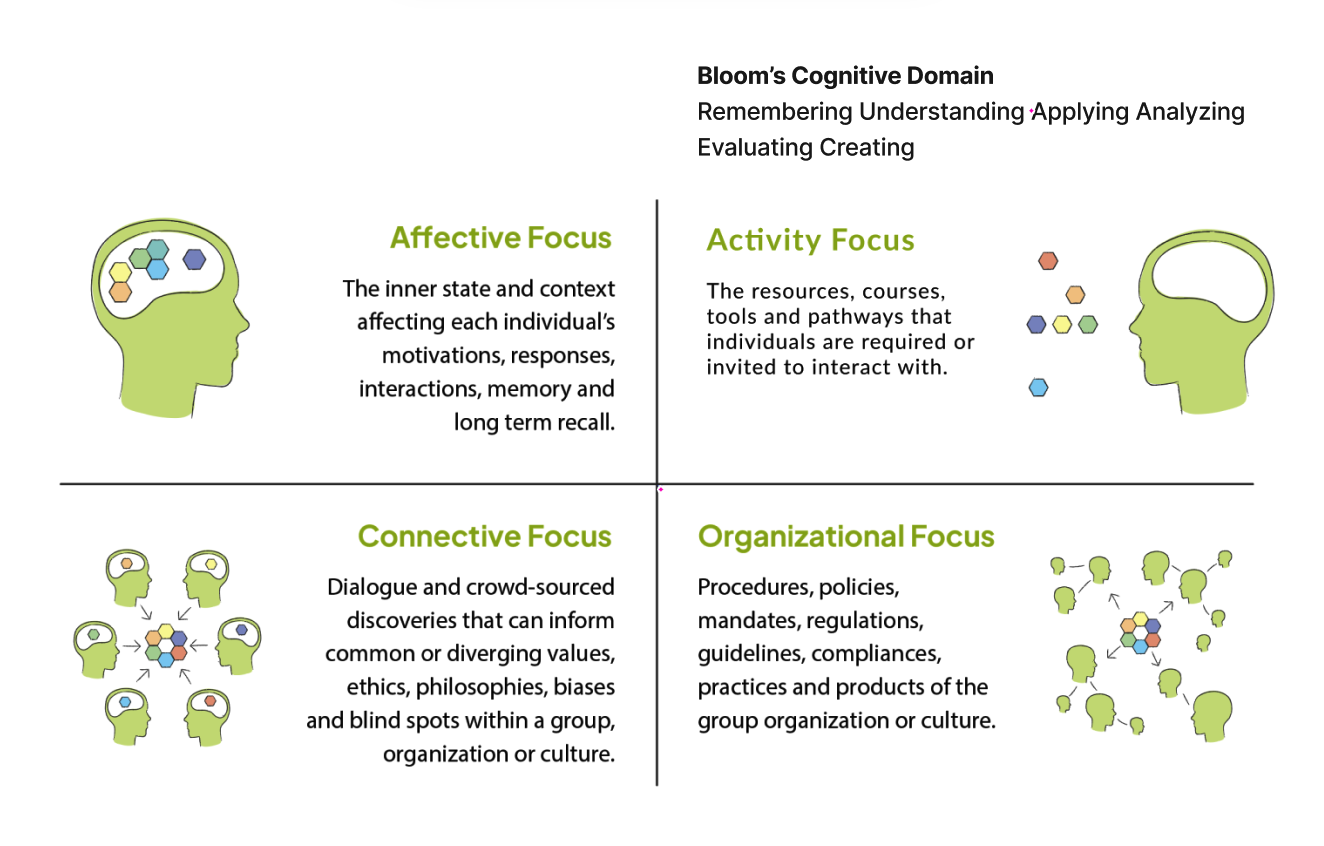
But what happened to the rest of the map?
The Forgotten Interior
To Bloom’s immense credit, his team designed a parallel scale specifically for the Affective state of the learner. It focused on willingness, motivation, and internal value shifts. A third taxonomy was the Psychomotor. In conventional design, both these scales are almost entirely ignored.
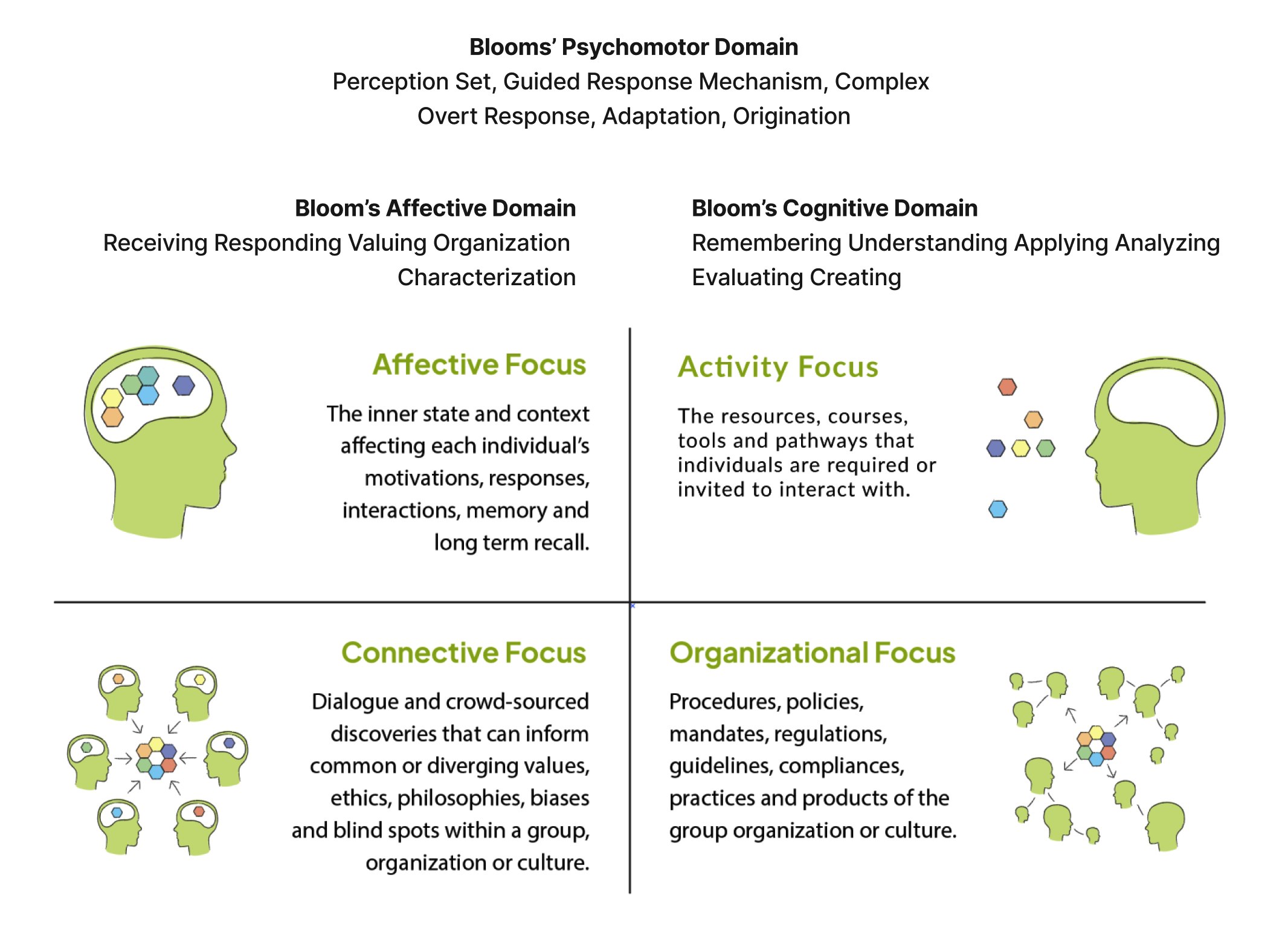
This neglect creates a massive blind spot for learning design. When we build digital modules that treat the learner’s emotional and motivational fingerprint as a minor detail, we end up with technically precise courses that fail to hook the learner’s actual attention. We write elegant compliance objectives but ignore the affective experience, cognitive exhaustion or low motivation.
The Connective Focus Quadrant gets at best a shallow, highly transactional treatment. It could charitably be said that connectivity is served by some of the typical call to action verbs associated with the cognitive taxonomy such as “explain” or “argue.” In online learning, however, objectives framed with these verbs are generally notional and rarely imply an real actionable intent.
By mapping these gaps, we can clearly see how we have historically traded deep, transformative human growth for the busy work of easy-to-track cognitive tasks.
Making Learning Significant
So the general use of Bloom’s sacrifices rich subjective experiences on the alter of simple, objective feedback loops.
Here’s where L. Dee Fink’s taxonomy of Significant Learning adds dimensions that both map perfectly and supply the Learning Focus Map with multiple calls to action.
Fink’s taxonomy treats deep learning as an integrated, relational experience where cognitive, emotional, and social dimensions grow together.
His categories align with the quadrants of our Learning Focus Map:
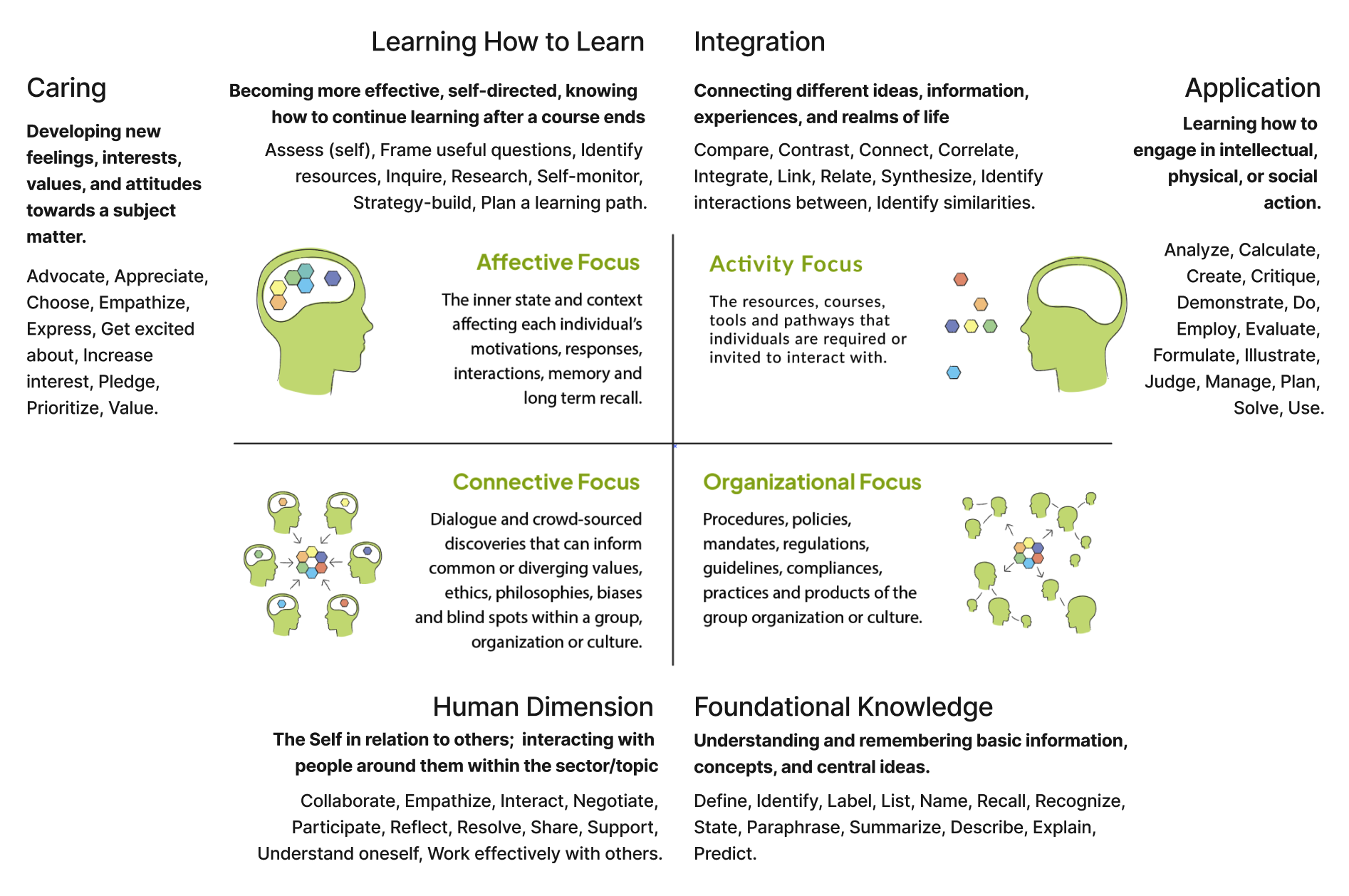
https://learnbase.com/wp-content/uploads/2026/06/Focus-Map-and-Finks.pdf
I hope you can begin to see how Fink’s dimensions give concrete actionable directives that both nest within and expand each of the four focus perspectives.
If you can consider a program you are working on (or learning within) and how it could be approached from each of the dimensions. Feel into how that changes the way you view the program you are making. How it unlocks you from the constraints of seeing everything simply through the pervasive activity-specific focus of Bloom’s Cognitive Taxonomy.
And crucially, Bloom’s Cognitive Domain is not banished in this evolution, it is nested within Fink’s Application dimension and actually a useful sub-taxonomy to use when dealing that dimension.
By using Fink’s categories to organize our design suggestions, we can build a much healthier learning environment. We move away from treating objectives as a checklist of tasks to be completed. Instead, we structure our work as a series of concurrent developmental shifts encompassing the whole living external and internal experience of the learner.
Download a copy of the Learn Focus Map and Fink’s TOSL here: https://learnbase.com/wp-content/uploads/2026/06/Learnbase-Focus-Map-and-Finks.pdf